Amir Baumann · 2 September 2026
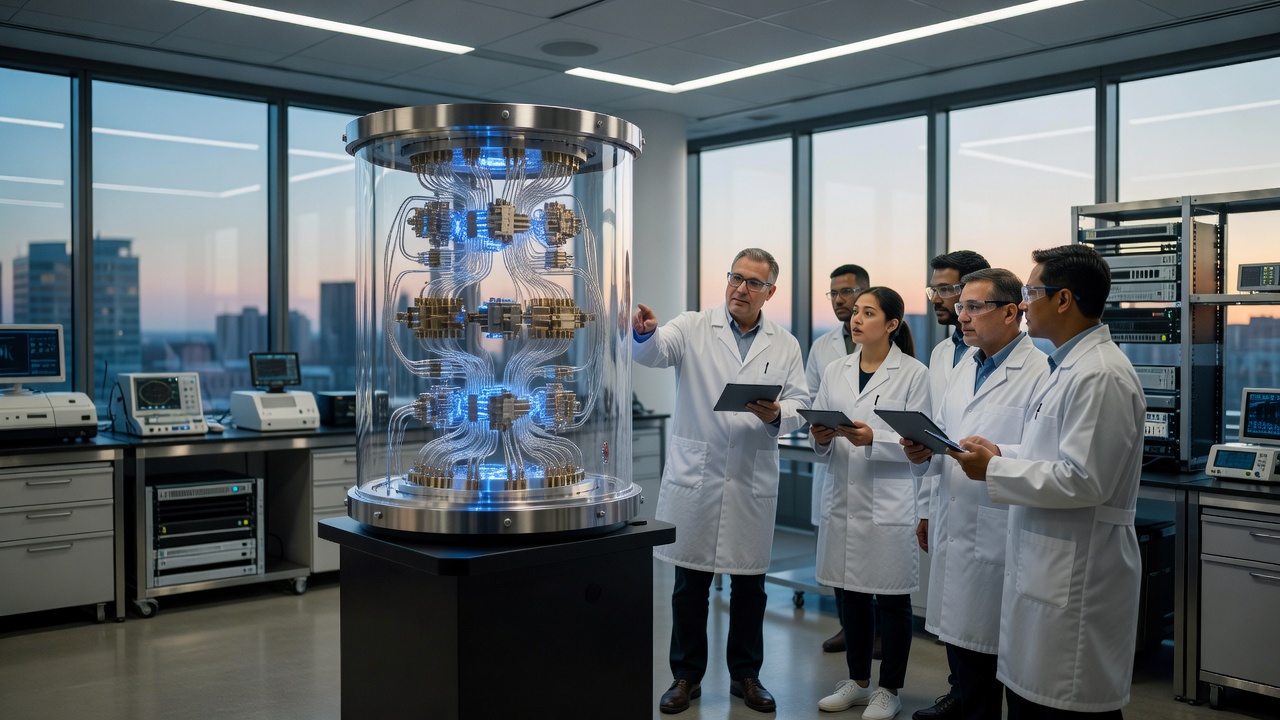
Core Laboratory Research has unveiled its latest innovation in the form of a quantum simulation platform tailored for physics investigations. This tool is set to transform how researchers approach complex quantum problems by providing enhanced computational power and precision.
Platform Features and Architecture
The platform employs state-of-the-art quantum algorithms combined with classical processing units to achieve superior simulation results. It is capable of handling systems with a large number of particles, offering insights into quantum entanglement and superposition effects. Users benefit from an intuitive graphical user interface that simplifies the setup of simulation experiments. Security features ensure that all data remains protected during transmission and storage. Furthermore, the architecture allows for scalability, meaning it can be upgraded as quantum technology advances. Training resources are provided to help users maximize the platform's potential in their studies.
Integration with existing laboratory equipment is seamless, enabling direct data input from experimental setups. This reduces the time required to iterate between theory and experiment. Performance benchmarks indicate a tenfold improvement over legacy systems in terms of speed and accuracy for standard quantum models. Additional modules for molecular dynamics simulations are included, allowing physicists to study quantum chemistry problems effectively. The development team has incorporated feedback from beta testers to refine the user experience.
Potential Applications in Physics
In the realm of condensed matter physics, the platform can simulate lattice structures and predict material properties under various conditions. High energy physics researchers may use it to explore particle interactions at quantum levels. The tool also supports astrophysics simulations involving quantum effects in extreme environments. By making these capabilities widely available, Core Laboratory Research aims to accelerate scientific progress globally. Future updates are planned to include support for quantum machine learning applications within physics contexts. The community has responded positively, with several research groups already expressing interest in utilizing the new system for ongoing projects.
Collaborations with industry partners will ensure continuous improvement and adaptation to emerging research needs. This platform stands as a testament to the laboratory's commitment to advancing scientific knowledge.