
Eden Krause · 30 September 2026
Open Data Resources Fuel Cross-Disciplinary Partnerships in European Research Centers
European research hubs have integrated open datasets into daily operations since the early 2010s, and this integration continues to reshape how teams from physics, biology, social sciences, and engineering exchange findings. Data shows that repositories maintained by institutions such as the European Organization for Nuclear Research and national archives now host millions of entries that researchers access without paywalls or institutional barriers.
Foundations of Open Data Networks Across the Continent
Countries including Germany, France, and the Netherlands established national open data policies that aligned with European Union directives on public sector information reuse, and these policies created standardized formats that allow seamless transfer between labs in different cities. Research indicates that by 2024 the number of registered users on platforms like Zenodo and the European Open Science Cloud exceeded 1.2 million, while download statistics from data.europa.eu reveal steady growth in cross-border queries each quarter.
Teams working on climate modeling now pull atmospheric readings from Scandinavian meteorological archives and combine them with soil samples uploaded by Mediterranean agricultural institutes, and this combination produces models that single-field groups could not generate alone. Observers note that the process requires shared metadata standards, yet once those standards exist the datasets flow into joint projects without repeated negotiations over ownership.
Case Examples of Multi-Field Projects
One project at the Barcelona Supercomputing Center merged genomic sequences from the European Genome-phenome Archive with urban mobility data released by the city of Barcelona; the resulting analysis identified correlations between air quality patterns and genetic markers linked to respiratory conditions. A separate effort in Warsaw paired high-energy physics collision data with economic indicators from Eurostat, and researchers discovered new variables that improved forecasts of supply chain disruptions during energy price spikes.
These examples illustrate how open datasets reduce the time required to assemble baseline information, while they also expose gaps in existing collections that prompt new collection efforts. In September 2026 the European Research Area conference will dedicate a full track to evaluating similar merged datasets, and organizers expect presentations from at least thirty cross-field teams.
Mechanisms That Enable Ongoing Exchange
Funding programs administered by the European Research Council now include requirements for data deposition within twelve months of project completion, and this rule has increased the volume of reusable material available to groups that lack large internal archives. Technical infrastructure such as persistent identifiers and version-controlled repositories further lowers the barrier for a biologist in Lisbon to incorporate a dataset originally produced by an engineer in Helsinki.
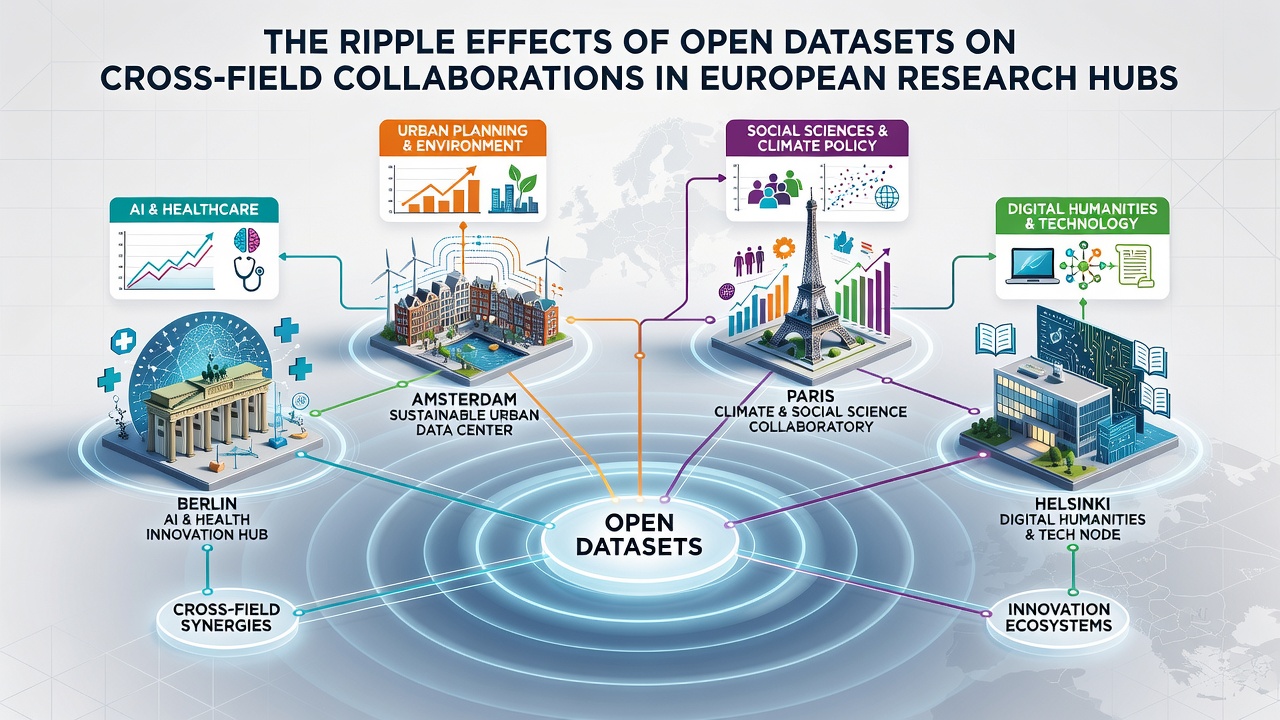
Training modules offered through the European Open Science Cloud teach metadata tagging and licensing selection, and participants report that these skills transfer directly to new collaborations. Figures released by the European Commission show that projects citing open datasets receive citations at rates 18 percent higher than comparable closed-data studies, according to an analysis covering publications from 2018 to 2023.
Challenges That Remain in Practice
Interoperability issues surface when datasets use incompatible units or missing provenance records, and these issues require manual cleaning that consumes research hours. Privacy regulations such as the General Data Protection Regulation impose additional review steps for any dataset containing personal information, even when the data have been anonymized at source. Some institutions still maintain internal repositories with restricted access, and this practice limits the pool of available material for teams that operate outside formal partnerships.
Despite these hurdles, working groups coordinated by the Research Data Alliance continue to publish guidelines that address format mismatches and licensing conflicts, and adoption of those guidelines has grown steadily since 2022.
Conclusion
Open datasets have become embedded infrastructure within European research hubs, and their presence supports an expanding range of cross-field projects that combine previously separate data streams. Continued policy alignment, infrastructure investment, and training programs will determine how far these collaborations extend in the coming years, while events scheduled for September 2026 will provide updated metrics on usage patterns and citation impacts.